by Grace Dawes | Nov 29, 2023 | Energy & Charging, Fleets, Interviews, MOVE America, Popular, Smart Cities, Smart Cities, Video, Videos |
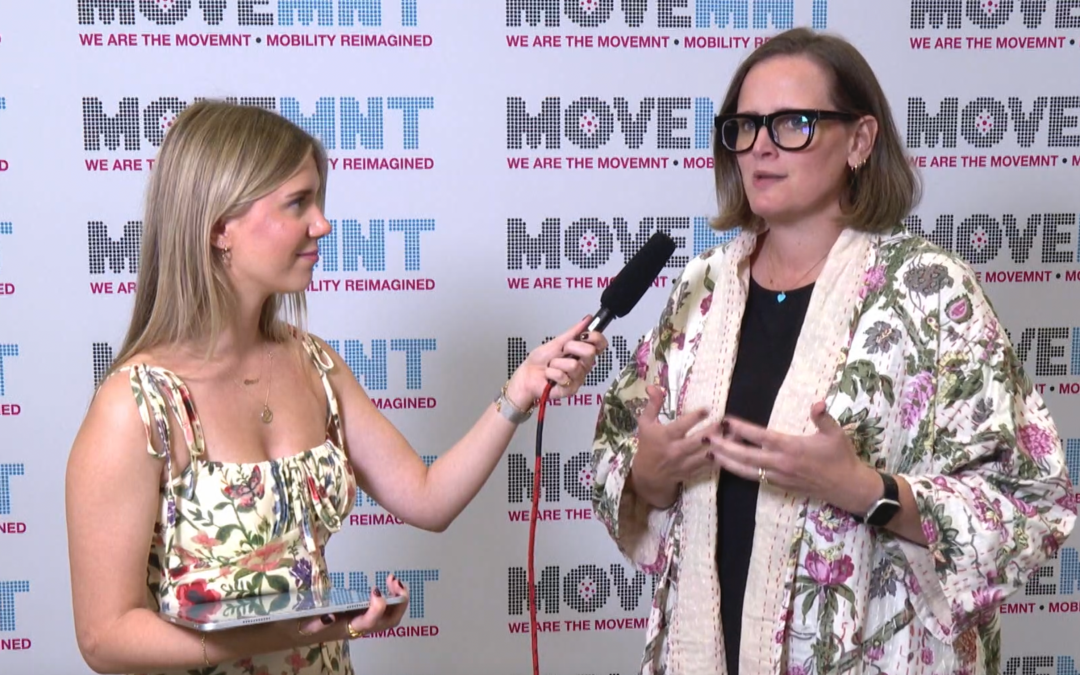
Emily Yates Chief Innovation Officer at the Southeastern Pennsylvania Transportation Authority (SEPTA) spoke to MOVEMNT at the MOVE America conference about women’s safety on public transportation.
Yates works specifically on the cross-overs between data, analytics, and policy at SEPTA and also oversees sustainability, therefore having a huge number of issues to be concerned with in public transport.
Yates mentions the significant concern over women’s safety on public transportation as she states that two-thirds of the people who use the SEPTA services are women. Therefore, women’s safety is a big focus for innovation. Yates discusses the development of live bus location and times via an app which the Authority hope will give more confidence to those using SEPTA’s services.
Watch the full interview to hear more on this plus an exclusive insight into what Yates discussed on her panel at the event, entitled “How to integrate new mobility services with minimal disruption”.
Want to keep seeing which stories are sparking the mobility community? Sign up to our MOVEMNT newsletter for weekly updates every Thursday 8am
by Grace Dawes | Nov 27, 2023 | Autos, Energy & Charging, Fleets, Popular, Tech & Data |
Aviation start-up ZeroAvia have announced that it has completed its Series C funding round at a total of $116m, including a $40 million backing from the UK Infrastructure Bank.
The fundraising round also received investments from co-leads Airbus, Barclays Sustainable Impact Capital and Saudi Arabia’s NEOM Investment Fund with the round set to accelerate the company’s journey to clean propulsion technology, hydrogen-electric engine production and zero-emission flights.
The company hopes that the funding will help to support the UK’s status as a market leader in research and development in both aviation and hydrogen as well as ZeroAvia’s growth plans within the UK.
Val Miftakhov, Founder & CEO, ZeroAvia said:
“This backing by such a pre-eminent investor as the UK Infrastructure Bank will help us deliver the first commercial zero-emission flights, and help the UK realise substantial export potential.”
Aviation contributes the equivalent of more than 38 million tonnes of CO2 from international and domestic journeys starting and ending in the UK. Around a quarter of UK carbon emissions are predicted to come from aviation in 2050. This funding in an emission-free and clean energy aircraft could provide support to the Government’s target of decarbonising aviation by 2050.
The company believes that a sustainable hydrogen ecosystem will be crucial for net zero and is an area in which the UK Infrastructure Bank is keen to act as a market leader.
Ian Brown, Head of Banking & Investments at the UK Infrastructure Bank, said:
“Aviation and hydrogen are sectors that need significant private investment to get to net zero. By providing confidence to investors, our equity has helped to crowd in the private investment needed for the continued development of this cutting-edge technology and should help stimulate the development and deployment of hydrogen technology across other hard to decarbonise sectors.”
Want to keep seeing which stories are sparking the mobility community? Sign up to our MOVEMNT newsletter for weekly updates every Thursday 8am
by Grace Dawes | Nov 22, 2023 | Business, Events, Popular, Tech & Data |
The United Auto Workers (UAW) Union members at Ford, General Motors and Stellantis have voted in favour of recently proposed contracts from the Big Three, locking in record gains.
With 64% of voting members ratifying the agreements, the majority vote will help to deliver hefty wage increases and a number of other gains that the union have been campaigning for during their six-week-long strike.
“The members have spoken. After years of cutbacks, months of our Stand Up campaign, and weeks on the picket line, we have turned the tide for the American autoworker,” said UAW President Shawn Fain.
Deals that were secured in the agreements by the autoworkers are similar across all of the Big Three. The summary of deals scored across the three automakers include members seeing a raise of at least 33% on wages and a faster rate of progression for workers to the top pay rate, falling from eight years to three years. See full details of the contracted agreements here.
The agreement is expected to create inroads for other non-union autoworkers as the UAW President is confident that the strike has inspired other autoworkers to campaign for better employment deals.
Fain added:
“The Stand Up Strike was just the beginning. The UAW is back to setting the standard. Now, we take our strike muscle and our fighting spirit to the rest of the industries we represent, and to millions of non-union workers ready to Stand Up and fight for a better way of life,”
The agreements have expectedly generated a number of similar responses from non-union plants in the US as significant wage increases surge across the auto industry. Toyota, Hyundai and Honda have all hiked their worker’s wages only days after the record deals were ratified by the majority vote.
Fain claimed that “thousands” of workers have already contacted the UAW and signed union cards.
He said:
“We are going to organise like we’ve never organised before, because our strike has shown the Nissan worker in Alabama, and the Volkswagen worker in Tennessee, and the Toyota worker in Kentucky, and the Tesla worker in California that when union members win, the entire working-class wins.”
Want to keep seeing which stories are sparking the mobility community? Sign up to our MOVEMNT newsletter for weekly updates every Thursday 8am
by Grace Dawes | Nov 21, 2023 | Autos, Business, Energy & Charging, Popular, Smart Cities, Tech & Data |
Hyundai has officially opened the Hyundai Motor Group Innovation Center Singapore (HMGICS) with the hopes of accelerating the delivery of the company’s human-centric future mobility vision and to potentially start developing robotaxis.
The facility introduces a new ‘smart urban mobility hub’ concept, which includes an automated flexible production system and provides ways for electric vehicle (EV) buyers to interact with their vehicles and the Hyundai brand.
The Group has claimed that they opened the facility as part of their strides towards creating sustainable mobility solutions. HMGICS hopes to provide as a sturdy pillar the company’s position in the electrification era over the next 50 years.
Hyundai has chosen Singapore as the home for the first smart urban mobility hub. With a human-centric manufacturing approach, HMGICS will enable a collaboration between people, robotics, and Artificial Intelligence (AI) technology in order to achieve new levels of synchronisation.
Integrated into the Jurong Innovation District urban landscape and the broader Singapore smart city ecosystem, the seven-story facility has the capacity to manufacture up to 30,000 EVs per year.
HMGICS has already produced IONIQ 5 and the fully autonomous IONIQ 5 robotaxi and will add IONIQ 6 to its portfolio of models built on-site next year. The facility will serve as a testbed for developing future mobility solutions — including Purpose Built Vehicles (PBVs).
Euisun Chung, Hyundai Motor Group Executive Chair, said:
“HMGICS is an open and connected urban innovation hub that encourages and embraces creativity and collaboration. It seeks to completely redefine the very concept of manufacturing.”
Want to keep seeing which stories are sparking the mobility community? Sign up to our MOVEMNT newsletter for weekly updates every Thursday 8am
by Grace Dawes | Nov 20, 2023 | Autos, Fleets, Popular, Smart Cities, Tech & Data |
Kyle Vogt has announced on X (formerly Twitter) that he has decided to step down as the Chief Executive Officer of Cruise following backlash and halted operations over a recent hit-and-run accident involving a Cruise autonomous vehicle (AV).
The accident occurred in San Francisco in early October where a pedestrian was hit by a human-driven car and then proceeded to be run over and dragged for 20 feet by a Cruise self-driving vehicle supposedly as a result of the AVs poor AI judgement. The accident led to the California Department of Motor Vehicles to revoke permits of the company’s AV deployment, a mass amount of scrutiny from the public, and eventually a pause on all Cruise AV operations.
San Francisco became the first US city this year to allow driverless taxis to transport passengers without the supervision of humans behind the wheel, as known as Level 4 AVs.
Vogt wrote on X that the “last 10 years have been amazing […] Cruise is still just getting started, and I believe it has a great future ahead,” adding that he is planning to spend time with his family and “explore some new ideas”.
There has been no officially named successor of the Chief Executive position, but Cruise have announced that its executive VP of engineering, Mo Elshenawy, would immediately assume the role as president and chief technology officer alongside Craig Glidden, who will serve as co-president as well as continuing in the role of chief administrative officer for the foreseeable future.
Want to keep seeing which stories are sparking the mobility community? Sign up to our MOVEMNT newsletter for weekly updates every Thursday 8am
by Grace Dawes | Nov 15, 2023 | Autos, Business, Fleets, Infrastructure, Interviews, MOVE America, Popular, Smart Cities, Smart Cities, Tech, Tech & Data, Video, Videos |
Michele Mueller the senior project manager of connected and automated vehicles at Michigan Department of Transportation (MDOT) discusses how the state are employing innovative technology in their safety systems to ensure people get home safely every day.
Mueller also talks about how the department are working with new start-ups to help expand and develop Michigan’s transportation system as well as the opportunity to meet these exact types of start-ups at the MOVE America conference.
MDOT are developing their systems by looking at the challenges within the transport infrastructure and working with industry partners to find solutions to these challenges.
Mueller explains that the department’s goal to make their systems smarter, more efficient, and most importantly, to help people get home to their families as safely as possible.
Want to keep seeing which stories are sparking the mobility community? Sign up to our MOVEMNT newsletter for weekly updates every Thursday 8am