News
Since its inception, the automotive sector has been tightly coupled with the defence sector. During the Second World War, European automotive manufacturers shelved their production of consumer vehicles en masse to focus on war production, developing guns, ammunition, military vehicles, and aircraft engines.
This symbiosis is predicated on several factors; both industries demand production at scale and rely on similarly complex and multifaceted supply chains. Equally, defence and automotive production use many of the same skills, with overlapping engineering expertise and production techniques.
As Europe’s car industry struggles in the face of intensifying Chinese competition and Trump’s imposed tariffs, some industry experts expect the historic symbiosis between the automotive and defence is set to deepen. This shift comes at a time when Europe is preparing to ramp up its military investment in the face of global conflict, an increasingly volatile relationship with the U.S., and the fracturing of the NATO alliance following Trump’s invasion of Greenland earlier this year. Last year, EU President Ursula von der Leyen described 2025 as an “era of rearmament”, a trend which has only escalated with recent disruption in the Middle East.
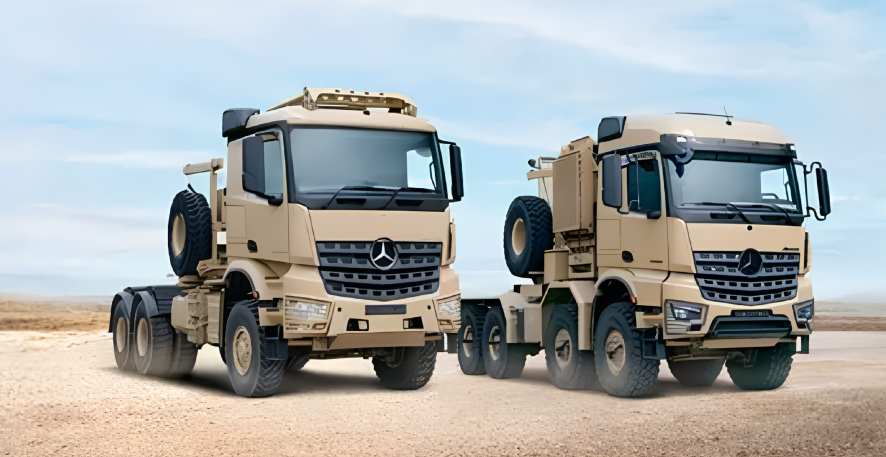
One such automaker considering this dual-use approach is German automotive brand Mercedes-Benz, which announced on Friday that it would be open to exploring military use cases.
In a statement to The Wall Street Journal, CEO Ola Källenius said:
“The world has become a more unpredictable place, and I think it is absolutely clear that Europe needs to increase its defence profile. Should we be able to play a positive role in that, we would be willing to do so.”
The group already has a significant stake in the military space and has significantly increased its military expenditure across Germany and the EU in recent years.
Källenius gave no specific roadmap for military production and stressed that defence would represent only a small proportion of Mercedes’ output and would not overshadow its core automotive business.
He added: “What car companies do extraordinarily well — and we’re good at it — is build high-quality precision machines at higher volumes.”
Mercedes is not alone in its effort to capitalise on Europe’s militarisation drive; Volkswagen is pursuing a dual-use strategy through alleged talks with several Israeli companies, exploring the possibility of turning its disused Osnabrück plant into a central hub for Israeli missile production.
The picture is similar in the U.S., where legacy OEMs General Motors and Ford Motor Company have reportedly entered talks with the Trump administration to fortify existing ammunition production amid ongoing conflict in Iran and Ukraine.
Similarly, in the UK, the government has specifically urged developers of autonomous vehicle technology to consider defence use cases. Speaking at Zenzic CAM Innovators Day, which MOVEmnt attended, Minister for Industry Chris McDonald said:
“If we had to scale up quickly in a conflict situation, I would encourage the sector to think about dual-use.”
It is clear that the remilitarisation effort is once again strengthening the relationship between the automotive and defence industries on a global scale.Whilst this connection is indisputable, in Europe’s case it remains unclear whether this strengthened partnership will offer the necessary reinvigoration to the continent’s squeezed automotive industry.
Some analysts and industry experts have warned that the European car market cannot rely on a dual-use strategy alone. Speaking to CNBC, IG Metall, Germany’s largest metalworkers’ union, stated: “The sectors operate too differently for that. Unlike in the high-volume automotive industry, for example, the defence sector is dominated by small-batch production. Even if production volumes are ramped up here, manufacturing will not resemble that of the automotive industry.”
Whilst a dual-use strategy may offer automakers like Mercedes a short-term antidote to declining sales, automotive manufacturers must remain adaptive beyond a single industry if they are to remain competitive on the global stage.
Keep up-to-date with the latest mobility news by subscribing to MOVEMNT’s free newsletter